

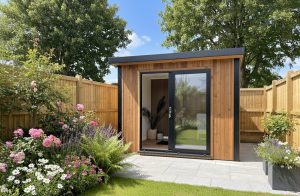
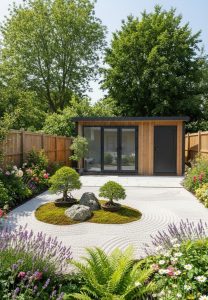
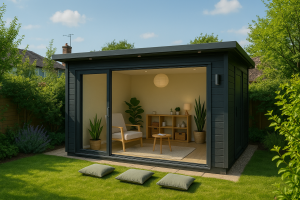
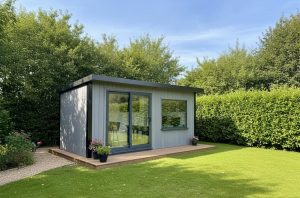
A guide to small garden rooms
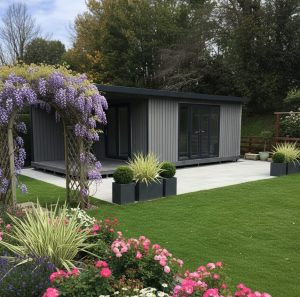
Don’t write off your garden just because it is on the smaller side. Many homeowners assume they need a massive plot for a garden office or gym, but that isn’t the case.
You don’t need to keep working from the dining room table just because square footage is tight. Small garden rooms have become the smart solution for maximising property potential, providing extra breathing room without dominating your entire outdoor area.
Small garden rooms have become especially popular because they provide extra breathing room without costing a fortune or taking up too much space. It’s about being smarter with the footprint you already have.
Can you really fit a garden room in a small space?
You might look at your small outdoor space and think a garden room is impossible. But with a custom-fit, small garden room, you can use the space you do have to its maximum potential.
Your small garden room options
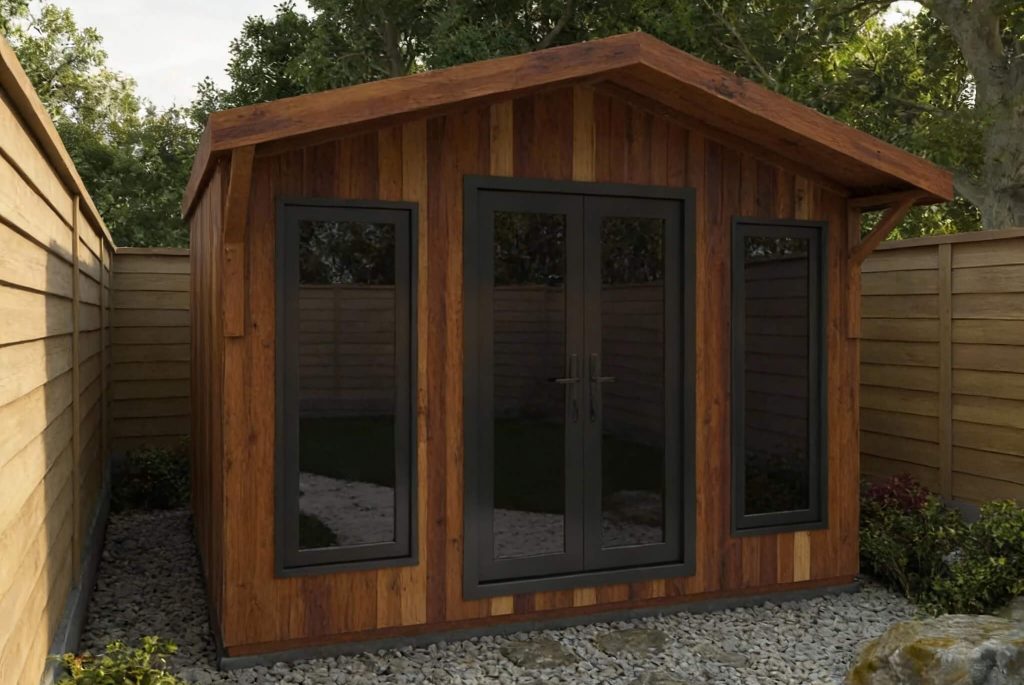
You don’t need a massive outdoor footprint to create a functional workspace. There’s a growing demand for micro garden offices and tiny garden rooms – you’re not alone working with limited square footage.
A compact studio is anything starting around 2m x 2m. This footprint provides plenty of room for a professional desk setup and shelving without taking over your outdoor area.
Compact designs, personalisable on our configurator, can be built for these tighter plots, ensuring they feel modern and open without the boxed-in feeling of a standard shed.
Standard garden room kits or custom-made?
Most online suppliers sell fixed-size kits or flat-pack pods. This is the biggest pitfall for small gardens. If your plot is 2.8 metres wide and you buy a standard 2.4 metre pod, you waste 40cm of space.
That dead space becomes a trap for weeds and debris that you cannot reach to clean. In a small garden, every inch counts. You cannot afford to throw away square footage. You need a design that pushes right to the available margin rather than floating awkwardly in the middle.
4 small garden room ideas to transform your space
Designing for a small garden means you don’t have the luxury of wasted square footage, so the room must serve its purpose perfectly. Here are some of the ways our clients take full advantage of their new compact garden room.
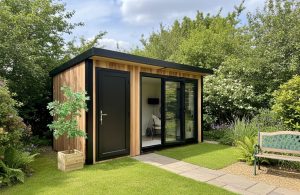
1. The small garden office
Working from the dining table kills productivity. A small garden office solves this by creating a boundary between your professional and personal life. We find that a 2.5m x 2.5m footprint is often the sweet spot for one person.
For those looking for a stylish, modern garden room that works well as an office, the Roseberry range is a popular choice. Its versatile design accommodates a full-width desk and shelving without feeling cramped.
Positioning the door on the side rather than the front can also free up internal wall space for monitors or storage units, creating a distraction-free zone that feels miles away from the washing machine.
2. Small garden gyms
You might think a home gym requires a double garage, but we install highly functional small garden gyms in surprisingly tight spaces. The main factor here isn’t just floor area – it’s the structure.
Our configurator is a popular starting point for compact home gyms, helping you visualise and design a space tailored to your training needs. Purpose-built garden gyms can be designed with reinforced flooring to support heavy equipment like squat racks and treadmills, while delivering comfortable, all-year usability.
Ventilation is equally important in a compact fitness space, so we recommend opting for opening windows or climate control to keep the air fresh during a workout.
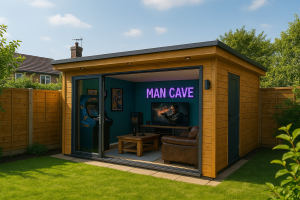
3. The man cave or hobby den
Sometimes you just need a place to escape. We see a rising trend in small man caves purely for relaxation, gaming, or watching sports. Because these rooms are detached, you can turn up the volume on the football or a movie without disturbing the main house.
High-quality insulation with acoustic properties becomes your best friend here. A compact 3m x 2.5m room easily fits a comfortable sofa, a wall-mounted TV, and a drinks fridge, giving you a private retreat that doesn’t encroach on the family living room.
4. Corner models: reclaiming dead zones
We all have that one awkward corner in the garden where nothing grows. A corner garden room is the best way to turn that dead zone into your most valuable asset.
By tucking the building right into the boundary angle, you keep the central lawn and patio area clear.
This orientation gives you the best view of the garden back towards the house, making the interior feel larger than it actually is. It is the smartest way to add a room without shrinking your usable outdoor space. Speak with our team for a bespoke corner design to fit that awkward space.
How to make a small garden room feel big
Square footage is only one part of the equation. A clever layout can make a compact studio feel twice the size of a poorly designed large garden room.
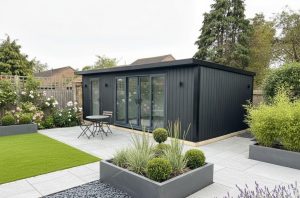
Glass walls and bi-folds
The most effective way to expand a small garden room is to remove the visual barrier between the inside and the outside. Floor-to-ceiling glazing creates a flow from the room to your garden, tricking the eye into seeing the patio as an extension of the floor.
Sliding doors or bi-folds are superior to standard swing doors in tight spaces. They do not encroach on your internal floor area or the decking when open, preserving precious square inches for furniture.
Smart storage and vertical space
Floor space is premium currency in a small garden office. If you clutter the ground with filing cabinets and boxes, the room will quickly feel cramped.
Look up instead. High wall-mounted shelving and tall, narrow units draw the eye upwards and keep the floor clear. For offices, consider a fold-down desk or floating shelves to maximise your usable footprint.
Lighting tricks for tiny interiors
Dark corners shrink a room. Positioning windows to capture natural light not only saves on electricity but also makes the interior feel airy and open.
Pair this with a light interior colour palette. Painting walls in soft greys or whites reflects light better than dark tones, boosting the sense of space. Mirrors placed opposite a window also work wonders by bouncing the garden view back into the room.
Planning permission for small garden rooms
One of the biggest worries we hear from homeowners is dealing with the council. The good news is that most small garden rooms fall under permitted development rules, meaning you usually don’t need formal planning permission. You just need to stick to a few strict limits.
Understanding the 2.5m height rule
To save space in a small garden, you typically need to push the building close to the fence/boundary.
However, if you position the room within 2 metres of your boundary, the maximum height of the building cannot exceed 2.5 metres. We design our small garden rooms so they sit under this height limit, allowing you to maximise your lawn without breaking any rules.
The 50% rule: covering your garden area
This is the regulation that often catches people out in compact gardens. You cannot cover more than 50% of the total land around your original house.
This calculation includes any extensions, sheds, or outbuildings added since 1948. In a tiny garden, a large studio might accidentally cross this line, so we help you calculate the exact footprint during our site survey to ensure you stay compliant with planning rules.
How much does a small garden room cost?
You likely want to know the bottom line before falling in love with a garden room design. The cost comes down to whether you choose a basic kit or a fully installed studio.
For a professionally built, fully insulated garden room, you should budget between £6,000 and £20,000. You will notice our turnkey garden rooms are the highest quality, most cost-effective solution offered in the UK. While you can find cheaper options online, these “shell prices” likely don’t include the essentials like foundations, electrics, installation, quality materials and VAT. We provide clear, upfront pricing so you know exactly where your money goes.
Mini garden office pods vs. insulated garden rooms
You will see mini garden office pods advertised for as little as £4,000. It is vital to understand the difference between these log cabin-style kits and a residential material-grade build.
Cheaper kits typically use single-skin timber walls. They heat up like greenhouses in summer and freeze in winter, making them unusable for half the year without expensive heating. A properly insulated garden room uses multi-layer construction, just like a timber-framed house, keeping you warm year-round.
Investing in quality materials upfront saves you money in the long run. Our premium garden rooms use durable composite materials that last for decades with very little maintenance needed, whereas a budget shed often requires annual treatments and repairs just to stay watertight.
Is your small garden ready for an upgrade?
Maximising a small garden isn’t about compromising on quality. Whether you need a dedicated office to separate work from home life or a compact gym to focus on fitness, a small garden room provides a convenient living space without taking over your entire garden.
Here’s what to take away:
- Avoid standard kits and opt for bespoke sizing to fit your unique plot.
- Choose a layout that fits your needs, whether it’s a desk, a treadmill, or a sofa.
- Build without the hassle of planning permission.
Don’t let a lack of space hold you back. If you have an awkward plot or a tight corner and want to know exactly what fits, let us measure it for you. Book a chat with our Noah experts, and let’s see what your small garden can actually do for you.
Frequently asked questions about small garden rooms
What is the smallest garden room I can build?
While you will see micro garden office pods for sale online with footprints as tiny as 1.8m x 1.8m, we generally advise a minimum size of around 2m x 2m to ensure the space is actually usable.
A tiny garden room might look cute on a plan, but once you add a desk, an office chair, and a monitor, it can quickly feel claustrophobic if you go too small.
Because we manufacture everything in-house at Noah, we are not limited to the rigid catalogue sizes you see elsewhere. If your plot can handle a width of 2.3m, we can build to that exact dimension rather than forcing you into a standard 1.8m kit.
This custom manufacturing and installation is crucial for small garden rooms, as it allows you to maximise your internal floor space without wasting precious land.
If you are worried about the room feeling tight, we can also design it with full-height glazing to flood the space with light, making even a compact garden office feel open and airy.
Do I need planning permission for a small garden room?
In the vast majority of cases, no. One of the biggest benefits of garden rooms for small gardens is that they almost always fall under permitted development rights.
To build without a full planning application, the structure must be single-storey and not exceed 2.5 metres in total height if it is placed within 2 metres of your boundary.
The building must also not cover more than 50% of the total land surrounding your original house.
Since small garden room ideas naturally focus on compact footprints, they rarely come close to breaching this coverage rule, making them a hassle-free option for terraced houses or city centre properties.
However, it is worth noting that if you live in a designated area, such as a conservation area or an area of outstanding natural beauty, different rules may apply. We always recommend checking with your local authority or letting us handle the compliance checks for you during a site survey to ensure your new space is completely legal.
Are small garden rooms warm enough to use in winter?
Yes. A common misconception is that a timber garden building is just a posh shed that freezes in December. Our small insulated garden office range is built with residential-grade insulation in the floor, walls, and roof, making it suitable for year-round use.
Unlike a conservatory, which loses heat quickly through glass roofs, or a basic summerhouse with single-skin walls, our rooms retain heat. Because the volume of air in a small garden room is lower than in a large studio, they are incredibly quick and cheap to heat.
A small electric panel heater is usually all you need to bring the room up to a comfortable temperature in minutes, even on the coldest winter morning.
This thermal efficiency means you gain a genuine extension of your home, perfect for a home office or reading nook, rather than a seasonal space that you have to abandon from November to March.
Is a garden room cheaper than a home extension?
When you look at the small garden office cost compared to a traditional brick extension, the savings are substantial. Brick extensions often mean deep trench foundations, heavy masonry work, and expensive architectural services, all of which drive the price per square metre up.
A small garden room delivers the same functional living space, whether you need a quiet office or a hobby room, without the heavy construction costs or the months of building work disrupting your home life. Many homeowners consider a small garden room attached to the house (a lean-to), thinking it will be cheaper, but the structural knock-throughs often make it pricier than a standalone build.
By choosing a detached garden room, you avoid the hidden costs of structural engineers and planning applications, giving you a high-quality, insulated space for a fixed price.
It is a cost-effective investment that adds usable square footage and value to your property.